
 Sign In
Fabrication of nickel and cobalt zinc ferrites on rice husk-derived activated carbon for application as microbial fuel cell cathodes

Acknowledgements
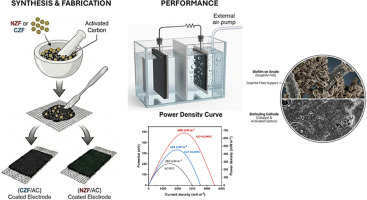
The slow oxygen reduction reaction (ORR) at the cathode remains a critical restriction for the practical application of microbial fuel cells (MFCs). In this study, Ni–Zn–Fe (NZF) and Co–Zn–Fe (CZF) oxide catalysts were synthesized via a sol–gel method and combined with rice husk-derived activated carbon (AC) as air cathodes for MFCs. Physicochemical analyses showed that both materials predominantly exhibited spinel-like characteristics. However, XRD and compositional analyses also identified secondary α-Fe2O3 phases and deviations from the nominal stoichiometry, indicating that the synthesized samples are more appropriately described as mixed-phase oxide systems rather than ideal single-phase spinel. Electrochemical analyses revealed contrasting trends between intrinsic ORR activity and practical MFC performance. Although CZF showed higher ORR activity in half-cell measurements, the NZF/AC cathode exhibited better performance during MFC operation with bamboo hydrolysate.
Preliminary MFC evaluations demonstrated that the NZF/AC-MFC achieved an open-circuit voltage of 437 mV, a maximum power density of 669 mW·m−2 and a current density of 4526 mA·m−2, representing up to a 2.41-fold increase over the AC-MFC control and outperforming the CZF/AC cathode. This superior performance might be associated with the combined effects of catalyst morphology, support interactions, charge transfer resistance, and the apparent reduction in cathode surface coverage observed after operation. These findings suggest that NZF/AC is a promising low-cost cathode material and highlight the importance of catalyst durability in complete MFC systems.
Citation
10.1016/j.jpowsour.2026.241584
Online
What do you need help with?

