
 Sign In
Ni(OH)2 interfaced with P-derived species electrocatalyst supported on hydrophilically modified carbon rods for enhanced acidic water splitting

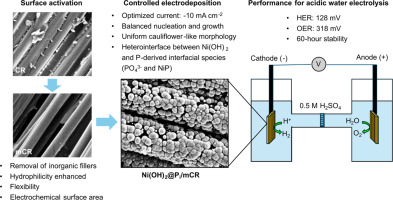
The development of durable, earth-abundant electrocatalysts for acidic water electrolysis is critical for large-scale green hydrogen production. Herein, we report a simple strategy to fabricate high-performance bifunctional electrodes by directly electrodepositing Ni(OH)2 nanostructures interfaced with P-derived species onto chemically activated, hydrophilic carbon rod substrates. Surface oxidation of the carbon rod effectively removes surface impurities, enhances wettability, and significantly increases the electrochemically accessible surface area, providing an optimal platform for catalyst growth. Controlled galvanostatic deposition enables precise regulation of nucleation, growth, and surface coverage, yielding a homogeneous cauliflower-like Ni(OH)2@Pi nanostructure uniformly anchored on the carbon substrate. The heterointerface formed between Ni(OH)2 and P-derived interfacial species (phosphate-dominated with minor phosphide contribution) enables synergistic water-splitting activity by inducing a favorable interfacial electronic configuration and accelerated charge transfer. As a result, the optimized electrode deposited at -10 mA cm-2 delivered low overpotentials for HER (128 mV) and OER (318 mV) in 0.5 M H2SO4, along with small Tafel slopes, high turnover frequency, and reduced charge-transfer resistance. Moreover, the binder-free electrode demonstrates excellent durability over 60 h at 10 mA cm-2, highlighting its promise for practical acid water-splitting applications under harsh and corrosive conditions.

