
 Sign In
Synthesis and characterization of porous SiO2/C composite from rice husks through activation with sodium hydroxide and its application in pouch cell Li-ion batteries

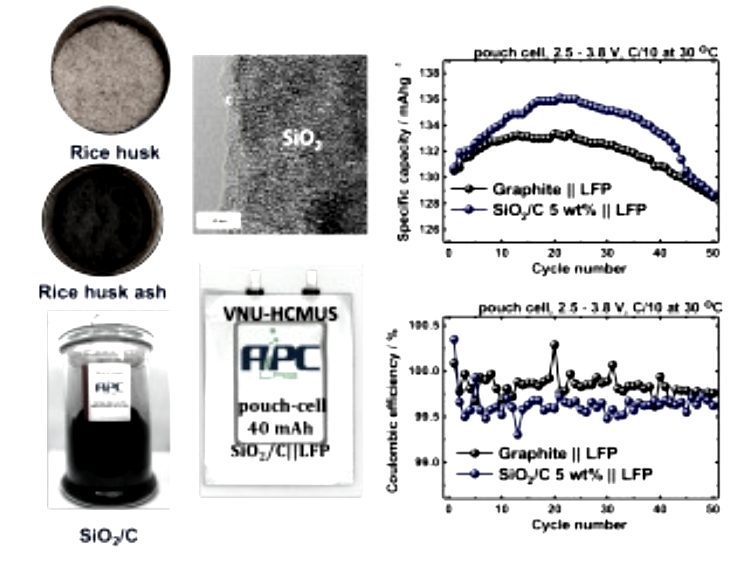
SiO2 is considered a promising candidate for future high-power energy Li-ion batteries thanks to its affordability and accessibility, low discharge potential (0.7 V vs. Li+/Li), and high specific capacity of 1965 mAh g-1. Rice husk naturally contains SiO2 in the form of nanoparticles, making it a reasonably priced anode material with a high silica content. In this study, amorphous and porous SiO2/C anode materials are successfully synthesized by calcinating rice husk with NaOH, an activating agent. The prepared anode materials exhibited a surface area of 210 m2 g-1 with pore sizes ranging from 50 to 100 nm. In addition, SiO2 particles were coated by a 3-5 nm carbon layer to depress volume expansion and thus enhance cycling performance. The SiO2/C anode provided a capacity of 1625.3 mAh g-1 in the 1st cycle and maintained around 645 mAh g-1 in the following 50 cycles. The optimal negative/positive capacity ratios were determined in coin cells and the high-capacity pouch cells (4 × 6 cm2 , 40 mAh) were further assembled to demonstrate a potential application of SiO2/C in highpower Li-ion batteries.

